
Vimshottari Dasha Guide
Understand the timing of important life periods
A birth chart describes planetary positions at the moment of birth. Vimshottari Dasha adds a timing layer: it shows which planetary period is active now and which periods follow. This free Vimshottari Dasha calculator uses your date of birth, exact birth time, and birthplace to calculate your Mahadasha and Antardasha.
Use the timeline as a Vedic astrology framework for understanding phases connected with career, relationships, education, finances, family, travel, and personal growth. It is not a fixed prediction. The meaning of any Dasha depends on the planet's sign, house, strength, aspects, conjunctions, and the rest of your Kundli.
What is Vimshottari Dasha?
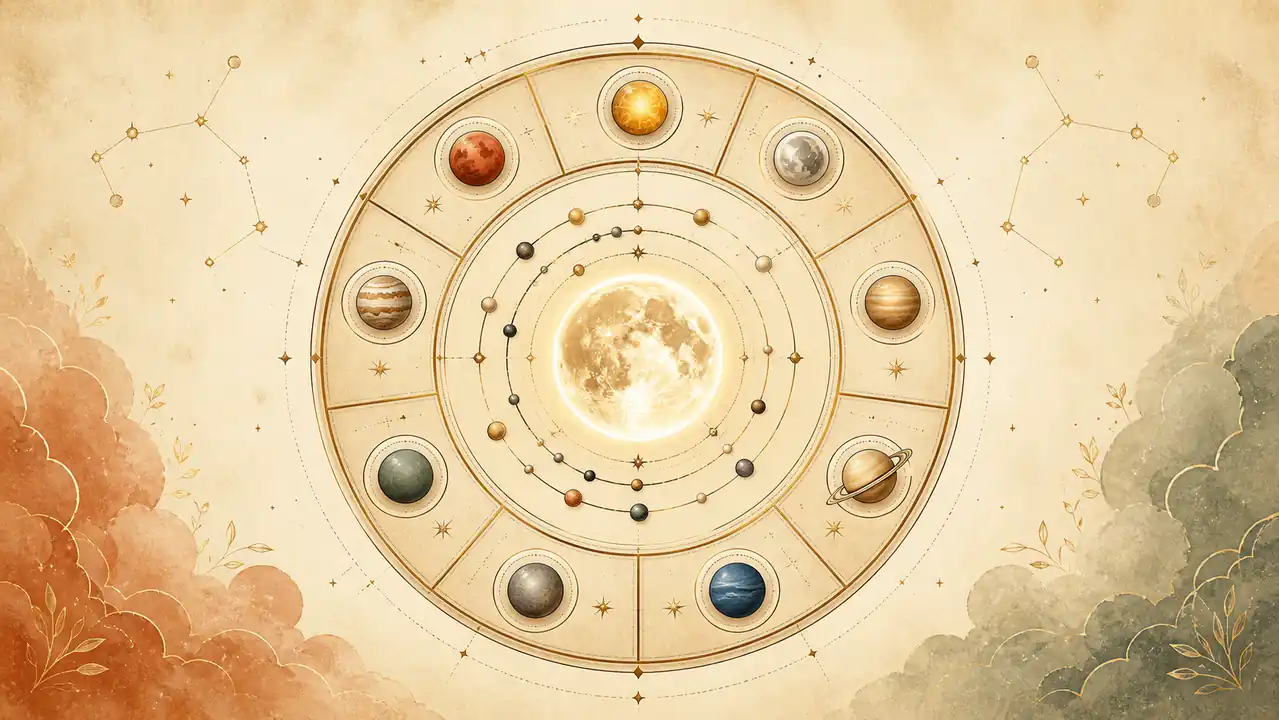
Vimshottari Dasha is one of the most widely used planetary-period systems in Vedic astrology. It follows a complete 120-year cycle shared among nine planetary rulers. The Moon's Nakshatra at birth determines the first Mahadasha and the remaining balance of that period.
7 years
20 years
6 years
10 years
7 years
18 years
16 years
19 years
17 years
Ketu (7), Venus (20), Sun (6), Moon (10), Mars (7), Rahu (18), Jupiter (16), Saturn (19), and Mercury (17) together total 120 years.
How does this Vimshottari Dasha calculator work?
- 1. Calculate the Moon's sidereal position. Swiss Ephemeris calculates the Moon at the exact birth time using the selected birthplace coordinates and timezone.
- 2. Identify the birth Nakshatra. The sidereal zodiac is divided into 27 Nakshatras; each is ruled by one of the nine Vimshottari planets.
- 3. Calculate the Dasha balance at birth. The Moon's position within its Nakshatra determines how much of the first Mahadasha was still remaining when you were born.
- 4. Generate the timeline. The calculator displays the Mahadasha sequence, the current period, and the Antardasha active inside it.
AstroVaanii applies Lahiri ayanamsa for the sidereal calculation. Selecting a birthplace from the suggestions provides the latitude, longitude, and local timezone needed for a consistent calculation.
What is Mahadasha?
Mahadasha is the main planetary period. It provides the broad timing context in which a planet's themes may become more prominent. For example, a Jupiter Mahadasha can bring attention to growth, learning, family, career opportunities, or spirituality, but the personal result depends on Jupiter's role in the full birth chart.
What is Antardasha?
Antardasha is the smaller sub-period within a Mahadasha. For example, Jupiter Mahadasha with Venus Antardasha combines both planets for a more specific period of analysis. Astrologers read the Mahadasha, Antardasha, chart houses, and transits together.
What is the difference between Mahadasha and Antardasha?
Mahadasha is the main planetary period that sets the broader theme of a life phase. Antardasha is the smaller planetary period running within it. Both planets are considered together when interpreting timing in a birth chart.
Why accurate birth details matter
Your date of birth establishes the day of the calculation. Your exact birth time helps place the Moon correctly within its Nakshatra. Your birthplace supplies the geographical coordinates and timezone. Small differences can change the Nakshatra, Pada, or the remaining balance of the first Dasha, especially when the Moon is close to a Nakshatra boundary.
For the best result, use the time recorded on official documents or confirmed by family. If the birth time is uncertain, treat the Dasha timeline as an estimate and consult the complete chart before making important decisions.
Current Mahadasha and what you can learn
Your current Mahadasha calculator result shows the active main period, its start and end date, and the current Antardasha. This helps you identify the relevant timing layer for a chart reading. You can then examine the ruling planets in your Kundli to explore topics such as career direction, business, relationships, marriage, education, financial responsibilities, travel, and spiritual development.
No Dasha is universally good or bad. Two people can experience the same Saturn Mahadasha very differently because Saturn may occupy different signs and houses, rule different houses, or receive different aspects in each chart.
How to use the Vimshottari Dasha calculator
Enter your birth date, exact birth time, and birthplace above, then select Calculate My Dasha. Review your Moon Nakshatra, current Mahadasha, and Antardasha. For a more personal interpretation, compare the active planets with your complete Kundli or birth chart, review any Rahu–Ketu axis pattern with the Kaal Sarp Dosha calculator, or ask Vaanii, the AI astrologer about your Dasha period.
Frequently asked questions
What is Vimshottari Dasha?
Vimshottari Dasha is the most widely used Vedic astrology timing system. It divides a 120-year cycle among nine planetary periods and uses the Moon's birth Nakshatra to determine the sequence active in your life.
How is my Vimshottari Dasha calculated?
The calculator finds the Moon's exact sidereal longitude at your birth time, identifies its Nakshatra and the Nakshatra lord, then calculates the remaining balance of that lord's Mahadasha at birth.
Why do I need exact birth time and place?
The Moon moves quickly. A precise birth time and selected birthplace improve the astronomical calculation and ensure the correct Nakshatra, Pada, timezone, and Dasha balance.
What are Mahadasha and Antardasha?
Mahadasha is the main planetary period. Antardasha is the sub-period within it. Reading both together gives a more focused timing context.