How AI Reads Your Birth Chart: The Science, Algorithms, and Future of Astrology
AI is not replacing astrology. It is changing the speed and structure of how a chart gets read. The core idea is simple: first the system calculates the sky, then it translates that calculation into language people can understand. If you want the hands-on version, you can try our AI Astrologer, compare it with the free Kundli generator, or explore the full tools section.
The short version
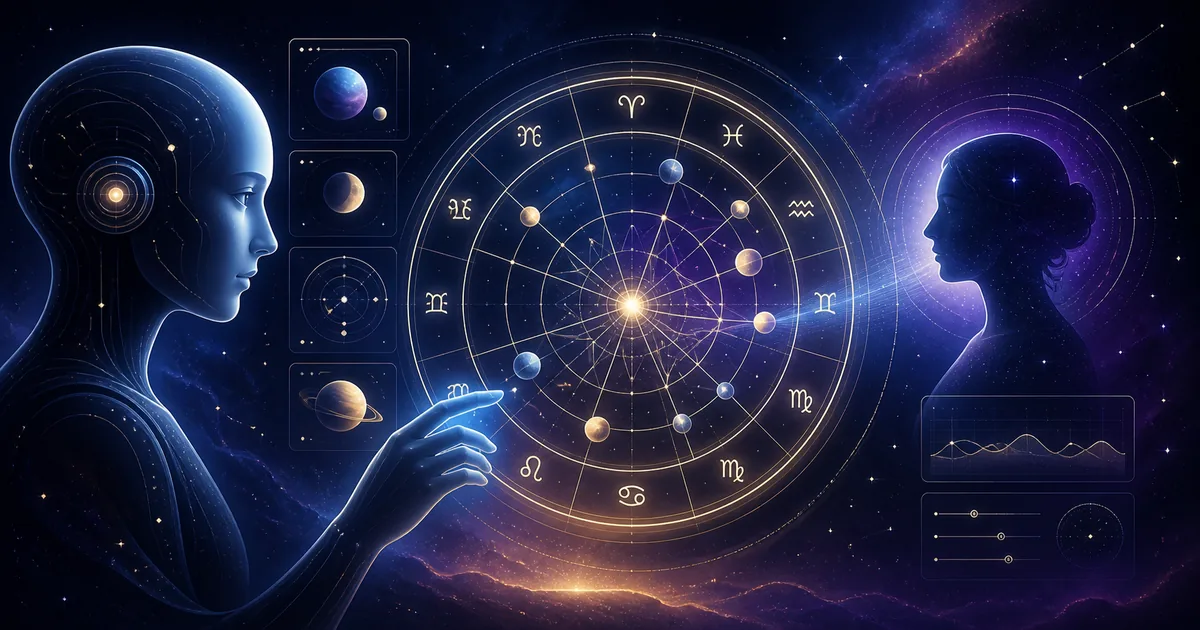
A useful AI astrology system does three things in order. It first collects accurate birth data, then turns that data into chart coordinates, and finally explains the result in natural language. The "AI" part is usually strongest in the explanation layer, not the mathematics. The mathematics still comes from an astronomical engine, the same kind of logic used when you compare charts in Kundali Matching.
That is also why a strong AI astrologer is more than a chatbot. It needs real chart calculations, real location data, and a clear interpretation layer. If you want a beginner-friendly overview first, start with What Is an AI Astrologer?. If you want to understand the rising sign that anchors the chart, read What Is Lagna?.
What is AI astrology?
AI astrology applies machine learning, natural-language processing, and astronomical calculation libraries to turn celestial positions into an understandable reading. For generations, a detailed chart meant consulting ephemerides, calculating placements from a birth time and location, and then synthesizing those symbols into a useful story. Software made the mathematical stage much faster, but early tools commonly joined prewritten paragraphs whenever a placement appeared.
A modern AI system can work with the entire chart context at once. Rather than treating Mercury in Aries and the Moon in Cancer as unrelated facts, it can explain how their signs, houses, aspects, and the question being asked interact. This is the difference between a static report and a more conversational AI astrologer experience.
How AI reads your birth chart, step by step
Step 1: Input data
Birth date, exact time, city, country, or verified latitude and longitude.
Step 2: Ephemeris calculation
Planetary longitudes, house cusps, retrograde states, and chart angles are calculated.
Step 3: Pattern matrix
The system maps aspects, element and modality balance, stelliums, and other chart configurations.
Step 4: Natural-language reading
The chart structure is translated into a contextual, human-readable explanation.
1. Raw input and geolocation processing
The process begins with a date of birth, an exact time, and a city or country. The location is converted into latitude and longitude, then the system checks the relevant timezone, daylight-saving rules, and historical regional time changes. Precision is essential: the Earth rotates about one degree every four minutes, and the Ascendant can change signs roughly every two hours. That is why a verified location matters when you create a free Kundli.
2. High-precision ephemeris calculations
With the time and coordinates established, an astrology engine queries an ephemeris: an astronomical dataset or calculation library that supplies the positions of the Sun, Moon, planets, nodes, and chart points for a particular moment. It calculates signs, degrees, house cusps, Ascendant, Midheaven, and retrograde states. At this stage there is no prediction or personality prose yet, only structured mathematical chart data.
Depending on the system, this can include the Sun, Moon, Mercury through Pluto, the nodes, Chiron and Lilith, plus the twelve houses. Western tools may use Placidus, Whole Sign, Koch, or Equal houses. Vedic readings use their own sidereal settings and chart conventions, so it is important not to compare outputs without checking the settings.
3. Structural matrix mapping
Next, the system maps relationships rather than treating placements in isolation. It checks major aspect angles including conjunctions, oppositions, trines, squares, and sextiles. It can also calculate the balance of Fire, Earth, Air, and Water, the balance of Cardinal, Fixed, and Mutable signs, and clustered configurations such as stelliums, T-squares, Grand Trines, and Yods. In a Vedic compatibility context, related structure is what makes Kundali Matching more meaningful than comparing Sun signs alone.
4. Natural-language synthesis and pattern analysis
Finally, a language model receives the calculated structure in a clear format. It can explain the interaction of multiple placements instead of listing disconnected facts. For example, a forceful Sun may read differently when it is closely challenged by Saturn, placed in a career-focused house, or supported by the Moon. A responsible AI reading frames these as themes for reflection, not fixed instructions for a person's life.
What AI adds after the chart is calculated
Traditional software could output isolated facts. AI is more useful when it connects the facts into a coherent explanation. A Sun in a strong sign means one thing on its own, but it means something different when it sits with Saturn, or when the Moon is under pressure, or when the 10th house becomes highly activated by timing.
Good AI astrology looks at the whole network of relationships: house lords, planetary strength, nakshatra, aspect balance, and current transits. That is why the answer feels tailored. It is not just repeating a line from a textbook; it is reading the chart as a system. If the topic is relationships, the same logic can also feed into Kundali Matching.
Where AI helps most
Speed and consistency
AI can analyze a chart instantly and answer follow-up questions without losing the thread. That makes it ideal for daily insights and quick exploration.
Pattern recognition
AI is strong at summarizing repeated chart themes, like career pressure, emotional sensitivity, or marriage timing, especially when the underlying calculations are accurate.
Multilingual conversation
A system like AstroVaanii can explain the same reading in different languages, which makes the result easier to understand for more people across India.
Better exploration
Instead of reading one fixed report, you can ask specific questions about career, love, health, or timing and get a more focused response.
The technical architecture behind AI astrology
Human-sounding output can make the process seem mysterious, but the technology is best understood as connected implementation layers. This is a technical view of the systems behind the workflow above, not a second chart-reading sequence: each layer has a different responsibility, from sourcing astronomical data to generating the explanation.
| Architecture layer | Core technology | Role in astrology |
|---|---|---|
| Data layer | Ephemeris data and astronomical tables | Calculates planetary degrees, retrograde states, and house cusps. |
| Logic layer | Chart rules, scripts, and APIs | Converts degrees into signs, houses, aspects, divisional charts, and other structured rules. |
| Context layer | Structured prompts and knowledge sources | Packages chart data with the relevant astrological framework and the user's question. |
| Language layer | Large language models | Turns the calculated structure into a clear, connected, and conversational explanation. |
When to use an AI astrologer or a human astrologer
Use AI when you want quick, repeatable chart calculations, a clear explanation of a placement, or a focused question about career, relationships, or timing. A human astrologer is often the better fit when you need an interactive conversation, nuanced personal context, or support around a sensitive life decision. The two approaches can complement each other rather than compete.
Use AI when you need
- Instant chart mathematics and broad pattern processing.
- Consistent explanations and around-the-clock access.
- Useful for exploring transits, placements, and focused questions.
- Accessible starting point for learners and repeat questions.
See a human when you need
- Live dialogue, intuition, and emotional awareness.
- Can respond to real-life context and sensitive circumstances.
- Brings lived experience, counseling judgment, and cultural nuance.
- Helpful for deeper ongoing guidance rather than quick exploration.
How to get better AI readings
- Use your exact birth time, not an estimate if you can avoid it.
- Choose the correct birth city so the timezone and coordinates are accurate.
- Ask one focused question at a time instead of requesting everything at once.
- Compare the answer with your own life experience before making conclusions.
- Cross-check the chart with other tools like free Kundli, Kundali Matching, and the tools page.
The future of AI astrology
The future is not about replacing astrology. It is about making the calculation layer faster and the explanation layer more conversational. Better systems will combine astronomical accuracy, chart-aware reasoning, and thoughtful language design so people can ask better questions and get clearer answers.
If you want to keep exploring, return to the AstroVaanii homepage, browse the blog index, or read the related guides on AI astrologersand Lagna.
Frequently Asked Questions
How does AI read your birth chart accurately?
AI begins with your birth date, exact time, and location. It converts that information into astronomical coordinates, calculates planetary positions, houses, and aspects, then uses a language model to explain the complete chart pattern in clear language.
Is an AI birth chart reading accurate compared with traditional astrology?
AI can be highly accurate for the mathematical work: planetary placements, house cusps, and aspects, provided the birth details are correct. Its interpretation is a structured guide, while a human astrologer can add personal empathy and live conversation.
Can AI calculate my Rising sign or Lagna correctly?
Yes, when the time and place of birth are precise. The Ascendant changes quickly because of Earth's rotation, so even a small difference in recorded birth time can change its degree or sign. Learn more in our Lagna guide.
Can AI predict future events from birth-chart transits?
AI can calculate upcoming transits, progressions, and timing cycles with mathematical precision. These are best understood as possible themes and timing windows, not guaranteed or deterministic events.
How should I prompt an AI to read my birth chart?
Share your date of birth, exact birth time, city and country, preferred system, and one focused question. For example, ask the AI to focus on career, relationships, or a particular house instead of requesting every possible topic at once.
What is the difference between standard computer astrology and AI astrology?
Standard software often joins fixed descriptions for individual placements. AI can synthesize multiple placements, houses, aspects, and the question you asked into one connected explanation, while still relying on the chart calculation engine underneath.
Does AI astrology work with Western and Vedic birth charts?
Yes. The calculation settings must be explicit because Western astrology commonly uses the tropical zodiac, while Vedic astrology uses a sidereal framework and may use different chart rules. AstroVaanii is designed around Vedic-style Kundli readings.
Why can an AI natal-chart reading feel so personal?
A natal chart contains many interacting variables: signs, houses, aspects, degrees, and timing. When an AI combines the full set rather than describing one placement at a time, the explanation can feel much more specific than a generic horoscope.
Can AI analyze synastry and relationship compatibility?
Yes. AI can compare two chart structures, including cross-chart aspects and relationship indicators. For a focused compatibility flow, use AstroVaanii's Kundali Matching tool.
Which house system does AI use by default?
That depends on the application. Western tools often default to Placidus, while Vedic systems use their own chart conventions. Always check the system before comparing readings from two different tools.
Is personal birth data safe in an AI astrology app?
Privacy depends on the service. Review its privacy policy before submitting personal details, especially birth time, location, and email address. Avoid sharing more identifying information than is needed for the reading.
Will AI replace human astrologers?
AI is better viewed as a calculation and exploration tool. Human astrologers bring empathy, active listening, cultural context, and counseling judgment that an automated reading cannot fully reproduce.
What should a beginner use first on AstroVaanii?
Start with the AI Astrologer for questions, generate your base chart with the free Kundli tool, or choose Kundali Matching if you want to compare two charts for compatibility.
Related reading and tools
Start the conversational reading flow and ask follow-up questions about your birth chart.
Open page →Generate the base chart before you interpret houses, signs, and planetary placements.
Open page →Compare two charts when you want to understand relationship compatibility.
Open page →Find your current Mahadasha and Antardasha from your exact birth details.
Open page →Check the Rahu and Ketu axis in a Swiss Ephemeris birth chart calculation.
Open page →See how AstroVaanii fits into the current AI astrology landscape.
Open page →A beginner-friendly explanation of the product category behind this article.
Open page →Understand the rising sign that forms the backbone of many chart readings.
Open page →